Aliens and native strangers
Two hundred years ago, the United States built Liberia as a place to ship its unwanted "aliens." Now it's using the country for the same purpose again.
On Tuesday, August 18, 2026, the government of Liberia announced that it will receive 20 people deported from the United States. They are expected at Roberts International Airport outside Monrovia within days, perhaps today. None are citizens of Liberia.
The announcement took the form of a letter to the country's own people, posted on the website of the Ministry of Information, unsigned, speaking throughout as "The Government of Liberia": the 20 people expected to land are the first of 1,200 people expected within a year, "Third Country Nationals" from African and Western Hemisphere countries, "medically authorized to travel," transferred under an arrangement the two governments concluded by an exchange of notes last September. All 1,200 are people who, in the letter's own phrase, "cannot return to their home of origin."
The letter wants certain things understood. The arriving people "are not criminals and are not being prosecuted in any manner under United States or Liberian law." They will be "received as guests of the Republic of Liberia" and "shall remain free to depart the country when they so desire." The transfer "is not a transaction with a quid pro quo"; Liberia "has not demanded or received any compensation or promise of reward," though it "will receive support to help manage the program." The gesture is "entirely humanitarian."
Near the end, the letter arrives at the reason for such a gesture: history. "Liberia itself was founded," the letter says, "as a refuge for freed slaves from the United States of America." The country's name comes from the Latin liber, so Liberia literally means "land of the free"; through the decades when it stood as the only independent country on a colonized continent it sheltered the "freedom fighters" liberating the rest, Nelson Mandela in Congo Town among them; and Liberia "has no history of deporting anyone for living in Liberia irregularly or without documentation." To accept these 1,200 is "in keeping with existing Liberian tradition." The letter closes by instructing the Liberian public to receive the new guests "with due courtesy" and "true African hospitality."
The founding cited by this letter left behind records—minutes, annual reports, account books, a price schedule written into federal law, a question written down beside each of its answers. They were kept by the men who did the founding, and they explain what those men meant by refuge.
The refuge is founded
On Saturday, December 21, 1816, at the Davis Hotel in Washington City, dozens of the most powerful men in the country met to plot the removal of Black Americans from the United States. They had the blessing of James Madison, the sitting president, and James Monroe, the president-elect. Henry Clay, Speaker of the House of Representatives, took the chair; the principal address came from Elias B. Caldwell, Clerk of the Supreme Court. That same Saturday, in Richmond, the Virginia General Assembly passed resolutions endorsing the same project: "colonization," in the language of the day, which meant transporting free Black Americans out of the United States to a colony overseas. The resolutions' author was a delegate named Charles Fenton Mercer.
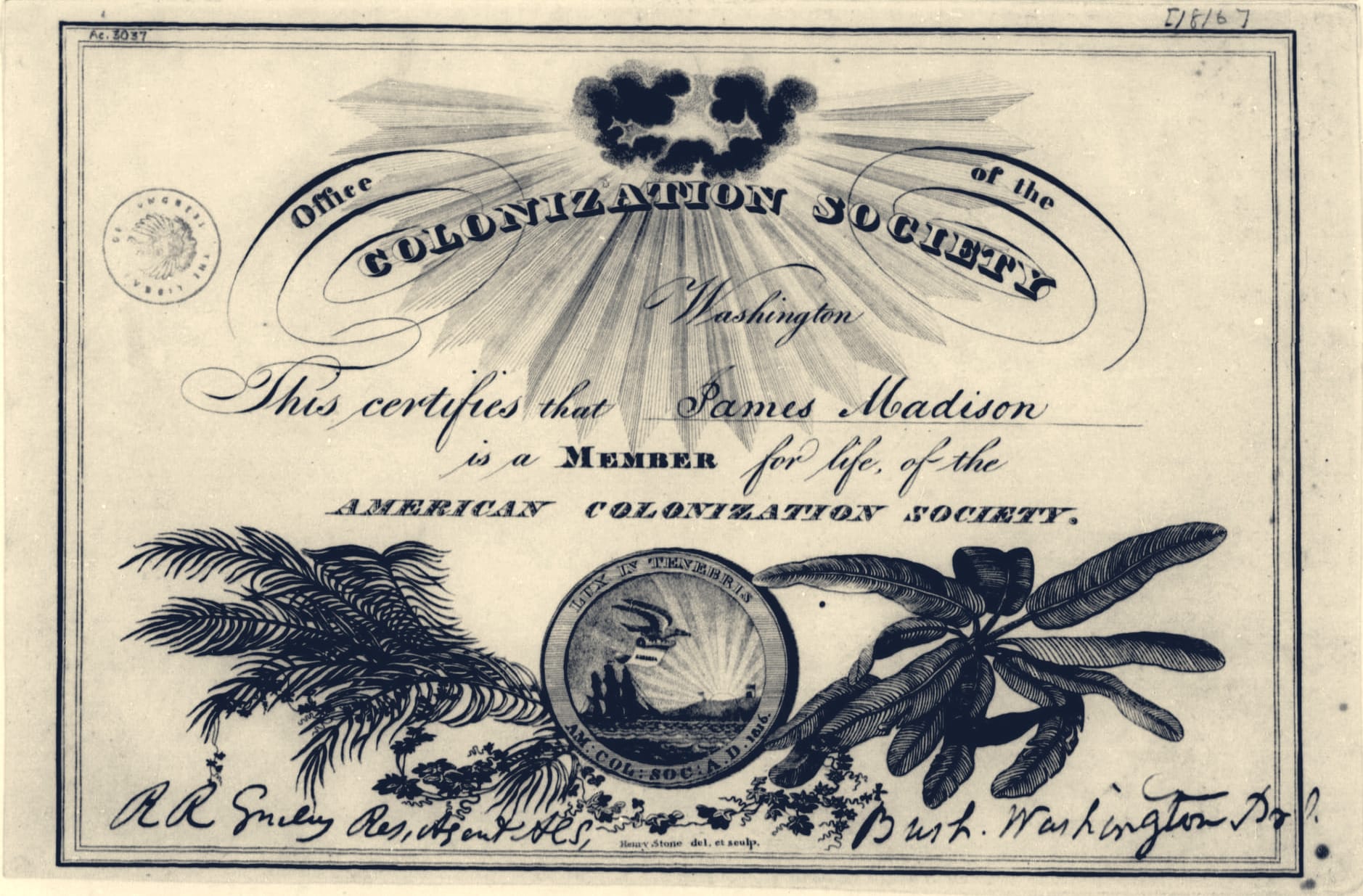
A week later, the new American Colonization Society adopted its constitution. The venue was the Hall of the House of Representatives. On New Year's Day it elected officers. President: Bushrod Washington, Associate Justice of the Supreme Court, on the bench since 1798. Secretary: Caldwell, the Court's clerk. Among the vice presidents at that first annual meeting: Henry Clay; Daniel Webster; Francis Scott Key; Andrew Jackson, major general in the Army. William H. Crawford, the sitting Secretary of the Treasury, held a vice presidency too. In the years ahead James Madison would serve as the Society's third president and leave it $2000 in his will; Chief Justice John Marshall headed its Virginia auxiliary; Monroe, his presidency finished, presided over an auxiliary of his own. The Society was private in the way the Hall of the House of Representatives is a room: technically.
Bushrod Washington led the Society from that first meeting in 1817 until his death in 1829. He was George Washington's nephew and the master of Mount Vernon, and in 1821 he sold fifty-four of the people he held there to buyers in Louisiana, dividing families between Virginia and the cotton frontier—this after he had gathered them to announce that he would free no one, and after some of them had tried to escape.
The colony imagined at the Davis Hotel got its capital city in time, and in 1824 the Society resolved to name it for the president of the United States. Thus the capital of the land of the free is Monrovia, for James Monroe, by vote of a private society in Washington presided over by a working slave trader.
The refuge is justified
The Society's constitution confined it to a single object: "to promote and execute a plan for colonizing (with their consent) the free people of color residing in our country, in Africa, or such other place as Congress shall deem most expedient." The parenthesis is in the original.
In 1818 the Society printed its first annual report, and ran in its appendix a letter one charter member had written to another the summer before. Robert Goodloe Harper had spent six terms in the House, sat briefly in the Senate from Maryland, and stood as a Federalist candidate for vice president. Writing to Caldwell, Harper takes up the utility of the colonization plan, and opens the accounting with the benefit to the people running the operation: "it is natural that we should be first struck by its tendencies to confer a benefit on ourselves, by ridding us of a population for the most part idle and useless, and too often vicious and mischievous." All emancipation "which permits the persons emancipated to remain in this country, is an evil." There should be no emancipation, Harper writes, "unless accompanied by colonization." And he makes a prediction, offered to the slave states as a promise of what their legislatures would do once a colony existed to receive free Black Americans: "They will annex the condition that the emancipated shall leave the country."
Robert Finley, the New Jersey minister who set the whole scheme in motion, had already run the same analysis in private. "Could they be sent to Africa," he wrote a friend in 1815, "a threefold benefit would arise. We should be cleared of them; we should send to Africa a population partially civilized and christianized for its benefit; our blacks themselves would be put in better condition." His pamphlet the next year explains what he meant by the latter: in America the free Black man would forever be "kept down" by a white prejudice "too deep rooted to be eradicated." Finley's remedy for the prejudice was the removal of the people it fell on. "Remove them," the pamphlet says; "place them by themselves," and "the hope of place and power will soon create the feeling that they are men." By the time the Society petitioned Congress in 1820, Francis Scott Key among the signers, the case had shortened: separation was best "for all the parties interested," on "many considerations, which need not be mentioned."

Henry Clay returned to the Hall of the House of Representatives—the room where the constitution had been adopted—to address the Society's annual meeting on January 20, 1827, and to say what free Black Americans were: "in the lowest state of social gradation — aliens — political — moral — social aliens, strangers, though natives."
Strangers, though natives. The Society's papers keep arriving at the same difficulty from different directions, and the letter in the 1818 report's appendix had already counted the injuries: the existence of a class of free people of color was "highly injurious, to the whites, the slaves, and the free people of color themselves." Injurious to everyone, that is to say, the injured included. The difficulty was never anything the free Black American had done; it was the fact of him. In a country whose law required Blackness to mean enslaveability, a free Black Virginian was a living contradiction—proof, visible from every field he passed, that the condition was not in the color.
What the Society proposed for that contradiction was expulsion, and the expulsion of the native-born was a thing without a name. Banishment came closest, but banishment was a sentence, and no one here had been convicted of anything. So the Society supplied a story instead, of return. The free Black American was recast as an African: Africa no longer the place his grandparents had been seized from but a nature he carried, removal no longer exile but homecoming. The story lacked only the home to come to. Where a destination was required and none existed, one would have to be built. Liberia was the theory of removal given a coastline.
The refuge is paid for
Charles Fenton Mercer of Virginia moved from the House of Delegates to the House of Representatives, and on March 3, 1819, the bill he wrote there became law: an Act in addition to the acts prohibiting the slave trade. Its nominal subject was the sea: it authorized the President to appoint agents "residing upon the coast of Africa" for receiving "the negroes, mulattoes, or persons of colour, delivered from on board vessels, seized in the prosecution of the slave trade." The act carried an appropriation of $100,000, and it carried a price schedule: $25 a head for every person delivered to the agents in Africa, $50 to the informer whose word produced the seizure. (It did not always prevent what it prohibited. The Africans of the Isabelita, taken off a Spanish slaver and smuggled into Georgia, were the kind of people the act was built for, and it failed every one of them: the governor of Georgia sold most into slavery and kept the proceeds for the state, and though the Society demanded the twenty-three who remained, the legislature handed them in 1826 to the smuggler who had bought them, as his lawful property. None reached Liberia, and none reached freedom.)
On December 17, 1819, Monroe announced to Congress his "construction" of the act: his duty was not merely to land the recaptured on the African coast but "to follow these unfortunates into Africa and make provision for them there until they should be able to provide for themselves." Provision, so construed, became land, agents, tools, and wages. An appropriation for returning the kidnapped had become the building fund for the colony, and its story of "return."
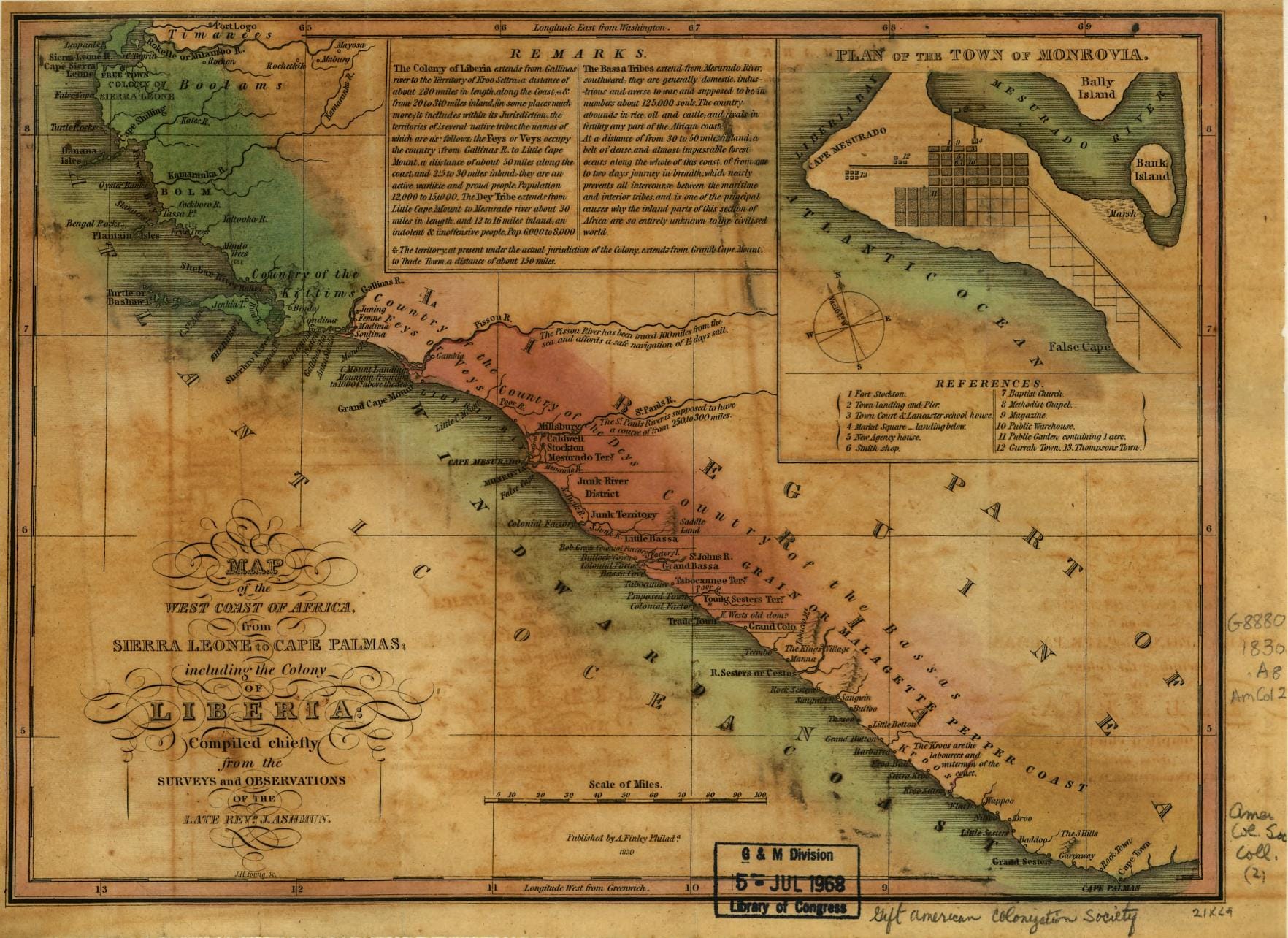
The money moved fast. Samuel Bacon, commissioned by Monroe and John Quincy Adams as "Principal Agent upon the Coast of Africa," chartered the merchantman Elizabeth, hired carpenters and laborers, and bought supplies for three hundred men for a year—this under a statute about captives from seized slavers. The Elizabeth sailed in early 1820 carrying some 86 emigrants, provisioned for a town. From 1822 the governor on the ground was Jehudi Ashmun, agent of the Society and representative of the United States—one man paid twice to run the colony.
The land of "the land of the free" came at gunpoint. In December 1821, Lieutenant Robert Stockton of the United States Navy persuaded King Peter to sell Cape Mesurado by pointing a pistol at his head; the State Department's own historians, telling the story a century on, use the word "coerced." A treaty of May 11, 1825, preserved in the Society's papers, records the price of a further tract: 500 bars of tobacco, three barrels of rum, five casks of powder, five umbrellas, 10 iron posts, and 10 pairs of shoes.
The federal payments stopped around 1830, once Jackson was president, and the states stepped in. Virginia appropriated $30,000 a year in 1850 for removal to Liberia, at up to $25 a head, and raised part of it with an annual tax of one dollar on every free Black man between twenty-one and fifty-five. Free Black men were taxed to pay for the removal of free Black people.
The federal spigot reopened, at the end, on the same terms it had opened with. On May 19, 1860, President Buchanan sent Congress a special message describing the arrangement he had made with the Society in September 1858, after the capture of the slaver Echo: the Society would receive recaptured Africans in Liberia "at the rate of $150 for each individual." He also asked Congress to make it standing: "a general agreement with the Colonization Society" to receive "all the captured Africans" on the coast. In writing, the President of the United States had requested a standing per-head contract with a private society for the delivery of deported people to West Africa. The refuge was purchased, by the head, with public money.
The refuge is refused
Twenty-five days after the Davis Hotel, on January 15, 1817, some three thousand Black men filled Bethel Church in Philadelphia—close to the entire Black male population of the city—to consider the plan the powerful men in Washington had made for them. The leaders who called the meeting were for it. James Forten, the sailmaker whose loft employed white and Black craftsmen side by side; Richard Allen, who had founded Bethel; Absalom Jones; John Gloucester: all spoke in favor of emigration. Then Forten put the question. He called for the ayes and heard nothing. He called for the noes, and 3,000 men answered in one voice, a no that seemed, as one account has it, as if it would bring down the walls of the building.
Ten days later Forten wrote to Paul Cuffe, the Black shipowner who had carried settlers to Sierra Leone at his own expense, and reported that not a single person in the church had favored going to Africa. Then he added something. He himself had not changed his mind—"they will never become a people until they com[e] out from amongst the white people," he wrote—but the room had spoken, and he had resolved to keep his own counsel and follow it. The plan's most respected Black advocates deferred to a unanimous refusal by the people it claimed to benefit.
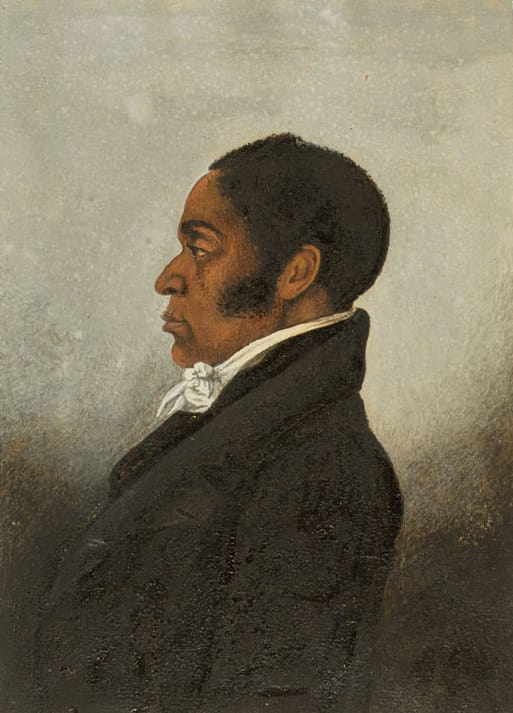
In August the refusal was put in writing. The address Forten and Russell Parrott signed on behalf of the free people of color of Philadelphia stated the refusal plainly: "we have no wish to separate from our present homes, for any purpose whatever"; the scheme "is not asked for by us". Then it looked down the road and predicted the consequences. The enslaved who most wanted freedom, those "who thus may become dangerous to the quiet of their masters, will be sent to the colony; and the tame and submissive will be retained, and subjected to increased rigour." And: "to emancipate and transport to the colony, will be held forth by slave-holders as the worst and heaviest of punishments." In the scheme's first year, they had described, in advance and exactly, what it would be used for: social control.
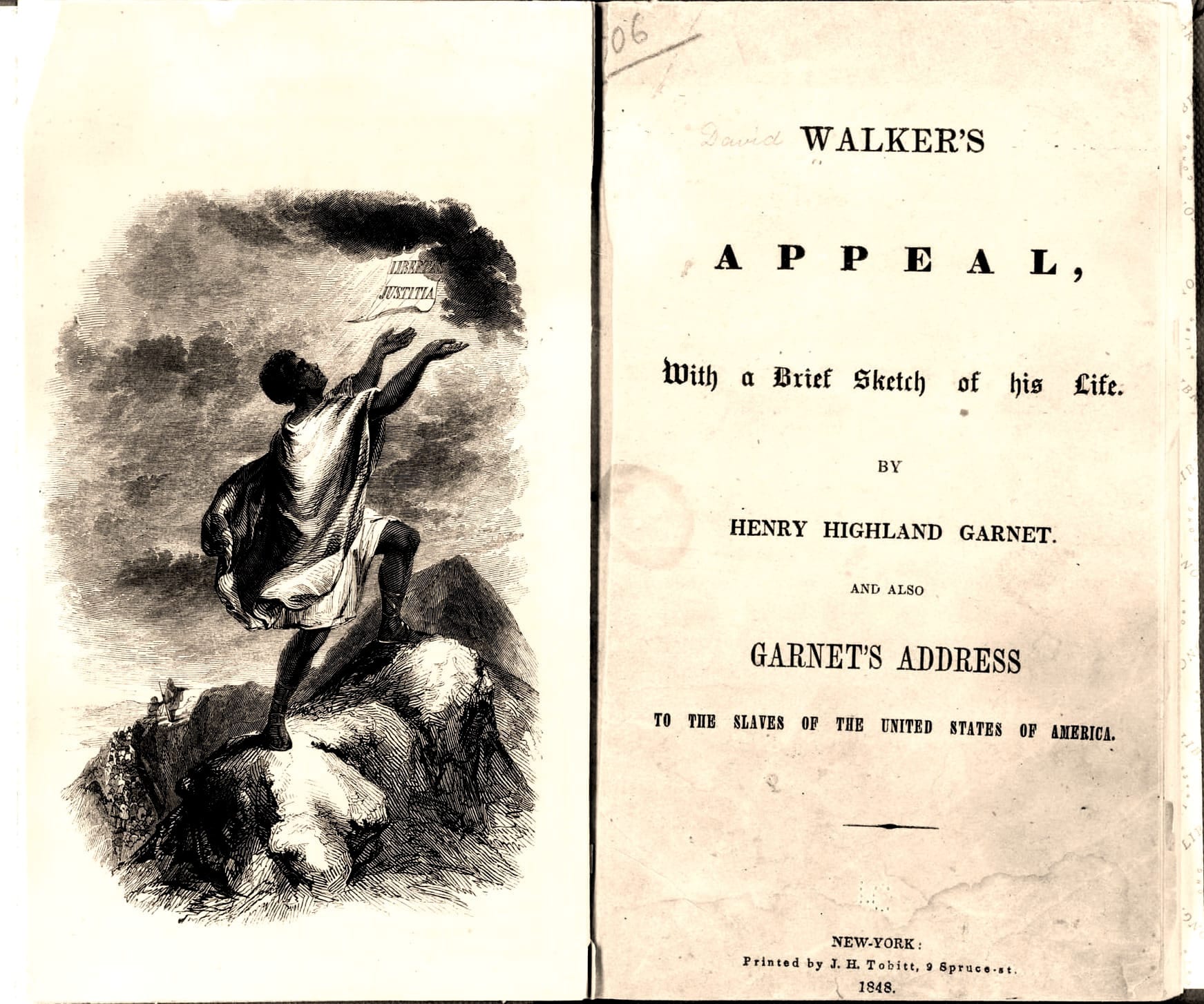
The refusal became a literature. David Walker's Appeal, 1829, gives colonization an article of its own, "Our Wretchedness in Consequence of the Colonizing Plan." Its method is reprinting the colonizationists and annotating them where they stand. Garrison's Thoughts on African Colonization, 1832, built its ten charges entirely from the Society's own annual reports, and disposed of the good-intentions defense in two sentences: "There is a wide difference between meaning well and doing well. The slave trade originated in a compassionate regard for the benighted Africans; and yet we hang those who are detected in this traffic."
In 1830 the first national conventions of free people of color met, at Bethel Church, Richard Allen presiding, and in June 1831 the second convention's address gave the refusal its permanent form. James Forten's name is in the 1831 minutes, on the Philadelphia committee; fifteen years after the consensus vote at Bethel, he was still in the room, and still following that forceful "no." The address said what the men in the church had said, at length and for the record:
"If we must be sacrificed to their philanthrophy, we would rather die at home."
The refusal was unanimous, it was in writing, and it was correct in every particular about what was coming. It changed nothing.
Over the next four decades the Society and its auxiliaries put more than 13,000 people on ships to Liberia, and by the Society's own rolls most of them were not free when they agreed to go. Virginia gave freedom a twelve-month fuse. Kentucky made staying a felony. Tennessee let a man be hired out until he had earned the price of his own removal. And on a December morning in 1847, on a plantation in Jefferson County, Mississippi, a doctor named John Ker assembled the adults a dead man's will had promised to free and put to each of them a question he had written down in advance, which amounted to this: would they prefer slavery at home, or "freedom" in exile?
Part two, to come: the vise, the death rates, and the nineteenth-century chickens coming home to roost.